
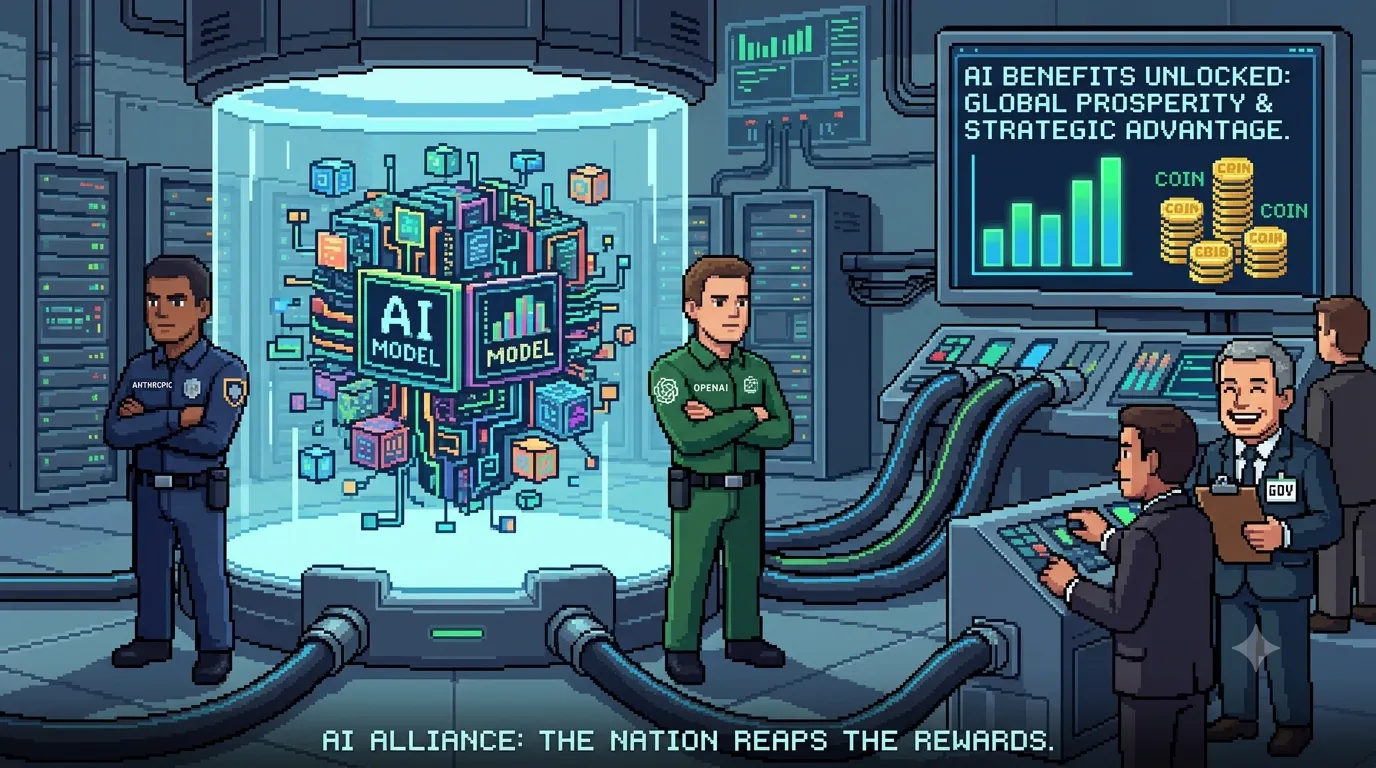
You’ve probably heard about Mythos, Anthropic’s latest frontier model. The demos are slick, the benchmarks look promising, and the press releases claim it’s “safer,” “more reliable,” and “enterprise-ready.” But here’s what no one’s talking about: you can’t use it. Not unless you’re a government agency or a Fortune 500 company writing seven-figure checks to Anthropic. This isn’t AI advancement—it’s AI enclosure. And it’s setting a dangerous precedent: the most capable models are being gated behind wealth and regulatory favor, not technical merit or public benefit.
The Problem: AI Is Becoming a Luxury Good
Look at the rollout of Mythos. It wasn’t released to the public. It wasn’t open-sourced. It wasn’t even made available via API to indie developers or startups. Instead, access was handed to select governments and deep-pocketed corporations—entities that can afford to pay Anthropic millions in licensing fees. This isn’t just elitism; it’s a structural shift in how frontier AI is governed. The people building small businesses, open-source tools, or community-driven AI applications? They’re locked out. Not because they lack skill, but because they lack capital.
The EU’s AI Act and the U.S. Executive Order on AI both encourage—or even require—model providers to report to governments before commercial deployment. That sounds reasonable until you ask: which governments? And who decides which models get flagged as “high-risk”? History shows that state actors have repeatedly compromised public trust—through surveillance overreach, algorithmic bias in policing, and opaque decision-making systems. Now we’re supposed to trust them with access to the most powerful cognitive tools ever built?
And let’s be clear: these models can make money. They can prevent financial losses. They can accelerate R&D. But if only those already in power get access, we’re not advancing intelligence—we’re amplifying inequality.
What Others Miss: Mythos Is Impressive Marketing, Not Verifiable Improvements Upon Existing Benchmarks
Here’s the uncomfortable truth: we don’t actually know if Mythos is better than existing models. We know one corporation claimed it found “20 potential code orange bugs” using the system. But we don’t know what those bugs were, how they were found, or whether a fine-tuned Llama 3 or DeepSeek-V3 could have found them just as easily with a similar deployment. There’s no public benchmark, no reproducible evaluation, no side-by-side comparison. It’s a testimonial, not evidence.
This is the new norm: private models releasing PR, not data. When only paying customers get access to real performance metrics, we lose the ability to validate claims. You can’t audit what you can’t see. You can’t improve what you can’t test. And you certainly can’t compete.
Stanford’s Center for Research on Foundation Models (led by Percy Liang) has repeatedly stressed the need for transparent evaluation frameworks. Yet the US foundational model companies are moving in the opposite direction. According to the DeepSeek-V3 Technical Report (November 2023), open models now match or exceed closed models on specific reasoning tasks—when given equal compute. But because closed models control the benchmarks, they control the narrative.
So when Anthropic says Mythos is “safer,” what they’re really saying is: “We’ve decided what safety means, and you’ll have to take our word for it.” That’s not governance. That’s enterprise sales.
A Practical Path Forward: Toward a Level Playing Field
I don’t have a silver bullet. But I do believe the best way to counter powerful, closed AI isn’t more regulation or waiting for governments to act—it’s to build powerful, open alternatives. And we already have the tools.
Consider this: the best defense against open-source AI misuse isn’t restriction—it’s better open-source AI. Want to stop AI-generated malware? Build open-source detection tools trained on real adversarial data. Want to prevent model poisoning? Use federated learning with verifiable updates. The Flower framework (by Daniel J. Beutel) already enables this kind of decentralized training with cryptographic guarantees.
Instead of relying on a single company’s “constitutional AI,” we should be building open, auditable safety layers. Projects like The Alignment Handbook are starting to document RLHF pipelines that anyone can replicate. We need more of that—open datasets, open reward models, open red-teaming frameworks.
The goal isn’t to eliminate private models. They’ll always exist. But we can ensure they’re not the only game in town. A level playing field means anyone with a good idea can compete—not just those with venture capital or government contracts.
Why This Affects You—Right Now
If you’re a developer, your workflows are already being shaped by who controls the models. Your data is being funneled into proprietary systems where you can’t see how it’s used. Your costs are rising because closed models charge premium rates for API access. And your team’s innovation is capped by what the big labs decide to release.
But look at what DeepSeek is doing. They’re releasing models that match GPT-4-level performance—and making them fully open. No paywall. No enterprise-only access. And they’re doing it at a fraction of the cost. This isn’t charity; it’s strategy. By commoditizing intelligence, they’re forcing the market to compete on workflow, design, and distribution—not just model size.
OpenAI, despite its origins as a nonprofit, now operates like a trillion-dollar tech giant. Its models are increasingly closed, its pricing opaque. Meanwhile, Anthropic is building a moat around Mythos, monetizing access to what should be a public good. But here’s the irony: the more they restrict access, the more they fuel the open-source counterwave.
If intelligence becomes a commodity, the winners won’t be the ones with the biggest models—they’ll be the ones who build the best tools around them. Your edge won’t come from access to a black box. It’ll come from how you use it.
What I'm Still Figuring Out
I’ll be honest: I don’t know how to govern superintelligent systems. If a model can outthink humans in every domain, should it be open at all? Maybe not. But I also don’t trust any single entity—corporate or governmental—to make that call alone. The current approach of “trust us, we’re safe” isn’t scalable. And I worry that open-sourcing everything could enable catastrophic misuse. But keeping everything closed guarantees that power consolidates in the hands of the few. I’m not sure there’s a clean answer—only trade-offs we haven’t fully mapped.
The Future: What If OpenAI Had Stayed Open?
Imagine a world where OpenAI had remained a nonprofit and open-sourced all its models. GPT-3, GPT-4, even GPT-5—freely available, auditable, modifiable. What would that have done to innovation? We’d likely have thousands of specialized derivatives: medical models fine-tuned on open datasets, legal assistants trained on public case law, educational tools adapted for low-resource schools.
Instead, we have a duopoly—OpenAI and Anthropic—controlling access to the most capable models. But the tide may be turning. In China, DeepSeek and others aren't just competing on price—they’re betting that open models will drive faster iteration, broader adoption, and ultimately, better outcomes.
By 2030, I expect to see large, well-funded open-source AI organizations—nonprofits, co-ops, or decentralized autonomous organizations (DAOs)—releasing models that match or exceed today’s frontier systems. They’ll be funded by grants, community donations, and decentralized compute networks. And they’ll prove that the best way to govern AI isn’t by restricting it—but by democratizing it.
The Hard Parts
None of this is easy. Open models require serious infrastructure—storage, bandwidth, compute. They’re vulnerable to misuse. And they struggle to match the polished UX of closed systems. But the hardest part isn’t technical—it’s cultural. We’ve been conditioned to believe that the best tech comes from elite labs with billion-dollar budgets. Breaking that myth means celebrating not just capability, but accessibility, transparency, and collaboration.
What to Do Next: My Advice for Builders
For CTOs and Engineering Leaders
- Evaluate open models like DeepSeek-V3, Llama 3, and Mixtral before committing to expensive closed APIs
- Run a POC using decentralized inference on Nosana to compare cost and latency
- Invest in internal red-teaming using open adversarial datasets from Hugging Face
- Push for model transparency in vendor contracts—demand benchmarks, not testimonials
For Developers and ML Engineers
- Start with DeepSeek-V3 on GitHub—it’s fully open, including training data and code
- Experiment with QLoRA fine-tuning using Hugging Face’s TRL library
- Deploy a model on Arweave + Nosana using the Nosana SDK
- Contribute to open safety projects like the Alignment Handbook or CAIP’s policy repos
For Researchers
- Read the DeepSeek-V3 Technical Report (November 2023) and compare its methodology to Anthropic’s published claims
- Explore open evaluation frameworks like EleutherAI’s lm-eval
- Study federated learning with differential privacy—Flower framework has strong tooling
- Investigate how MoE architectures can be made more transparent and auditable
For Policy Makers
- Ask: who benefits from current AI access policies? Is it the public, or just incumbents?
- Monitor the risk of “regulatory capture,” where agencies become dependent on private AI providers
- Support funding for open AI initiatives, not just partnerships with Big Tech
- Require public benchmarks for any model deemed “high-risk” under AI regulations
For Curious Learners
- Join the Hugging Face Discord and explore open model demos
- Take the free fast.ai course on practical deep learning
- Follow the Alignment Forum for debates on open vs. closed AI
- Read the “Open Foundation Models” paper from Stanford’s CRFM
This post is part of the DecentralizeAI Hackathon — made possible by Nosana (decentralized GPU compute), Arweave (permanent decentralized storage), MEXC (crypto exchange), and HackerNoon. Discuss on HackerNoon with #DecentralizeAI. Especially interested in hearing from people who've tried governance in production.